
Fuel cells - the cleaner energy source
What is a fuel cell?
With the rate of rise of fossil fuel depletion,
it is of utmost importance to come up with sustainable alternate clean energy.
One of the solutions for this imminent problem is fuel cell. Fuel cells are arguably a clean source of energy, as it converts the chemical energy
of hydrogen (fuel) into electricity and heat with oxygen acting as the oxidizing agent without any emission.
As the usage of fuel cells increases in different domains such as transport, a need for efficient usage of the fuel cell is necessary.
There is a need to maximize the usage life of the fuel cell and take control system measures to ensure maximum efficiency and life.
A fuel cell is an electrochemical cell that converts the chemical energy of a fuel (often hydrogen) and an oxidizing agent (often oxygen) into electricity through a pair of redox reactions.
Fuel cells are different from most batteries in requiring a continuous source of fuel and oxygen (usually from air) to sustain the chemical reaction, whereas in a battery the chemical energy usually
comes from metals and their ions or oxides that are commonly already present in the battery, except in flow batteries.
Fuel cells can produce electricity continuously for as long as fuel and oxygen are supplied.
There are many types of fuel cells, but they all consist of an anode, a cathode, and an electrolyte that allows ions, often positively charged hydrogen ions (protons), to move between the two sides of the fuel cell.
At the anode a catalyst causes the fuel to undergo oxidation reactions that generate ions (often positively charged hydrogen ions) and electrons.
The ions move from the anode to the cathode through the electrolyte.
At the same time, electrons flow from the anode to the cathode through an external circuit, producing direct current electricity.
At the cathode, another catalyst causes ions, electrons, and oxygen to react, forming water and possibly other products.
Fuel cells are classified by the type of electrolyte they use and by the difference in startup time ranging from 1 second for proton exchange membrane fuel cells (PEM fuel cells, or PEMFC)
to 10 minutes for solid oxide fuel cells (SOFC).

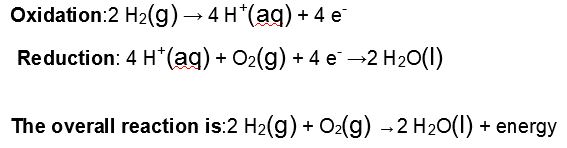
The reactions taking place inside the Fuel cell is given below
The fuel cell family
The following are some of the typically used Fuel Cells
- Proton Exchange Membrane Fuel Cell [PEMFC]
- Solid Oxide Fuel Cell [SOFC]
- Alkaline Fuel Cells[AFC]
- Direct Methanol Fuel Cell [DMFC]
- Solid Acid Fuel Cell [SAFC]
- Phosphoric Acid Fuel Cell [PAFC]

Real time applications
The use of fuel cells is classified into three broad areas:
-
Portable power generation:
Power shortages are a major concern in domains like manufacturing, health and hospitality.
A typical Diesel generator used in hospitals and residential areas can take up to 2 minutes to activate and stabilize.
In the era of automation where delicate surgeries are performed by robotic arms, A power failure of even 2 seconds can cause havoc.
In a typical assembly line, each pit stop is timed and accounted for so as to minimize the loss and maximize the profits.
A power failure of even 2 seconds can cause the whole assembly line to slow down.
-
Stationary power generation:
Although it is a niche field, a lot of work has been going on in developing stable fuel cell generators of high capacities.
Hydrogenic’s MW POWER PLANT is the best example that produces 1MW energy.
-
Power for transportation:Fossil fuel consumption has been increasing day by day and everyday.
It has been estimated that by the year 2035, the whole world is going to run out of fossil fuel.
When in 1960s, the automobile sector started blooming, the supply-demand problem was between consumer and a model.
But now, the same supply -demand problem has shifted to model and fuel.
Consumer now is least bothered about the make of the car but is more worried about its MPG or Mileage.
This is the perfect place for fuel cell vehicles to bloom. In fact a lot of German manufacturers and Japanese manufacturers like VW, Toyota have been working on fuel cell vehicles and also have
commercial models such as the MIRAI as Clarity that gives out 22MPG(for MIRAI)(With engine output comparable to that of a 2l diesel engine found in MPVs and SUVs).
The specialty of fuel cell vehicles over electric vehicles that run on Li-ion batteries is refueling time.
When a Tesla supercharger takes 22 minutes to full charge, refilling time of Hydrogen tank is 3 minutes.
Aviation industry too has been looking for alternatives such as bio fuels and solar energy for the future.
The cheetah project by NASA is a promising one.
DS-30 by Guinn partners and Doosan Mobility solutions have successfully tested a drone that had a flight time of 1hour 43 minutes with 30 minutes left unused.
So the future of fuel cells in the automobile and aviation sectors indeed looks promising.
This is the perfect place for fuel cell vehicles to bloom. In fact a lot of German manufacturers and Japanese manufacturers like VW, Toyota have been working on fuel cell vehicles and also have commercial models such as the MIRAI as Clarity that gives out 22MPG(for MIRAI)(With engine output comparable to that of a 2l diesel engine found in MPVs and SUVs). The specialty of fuel cell vehicles over electric vehicles that run on Li-ion batteries is refueling time. When a Tesla supercharger takes 22 minutes to full charge, refilling time of Hydrogen tank is 3 minutes. Aviation industry too has been looking for alternatives such as bio fuels and solar energy for the future. The cheetah project by NASA is a promising one. DS-30 by Guinn partners and Doosan Mobility solutions have successfully tested a drone that had a flight time of 1hour 43 minutes with 30 minutes left unused. So the future of fuel cells in the automobile and aviation sectors indeed looks promising.